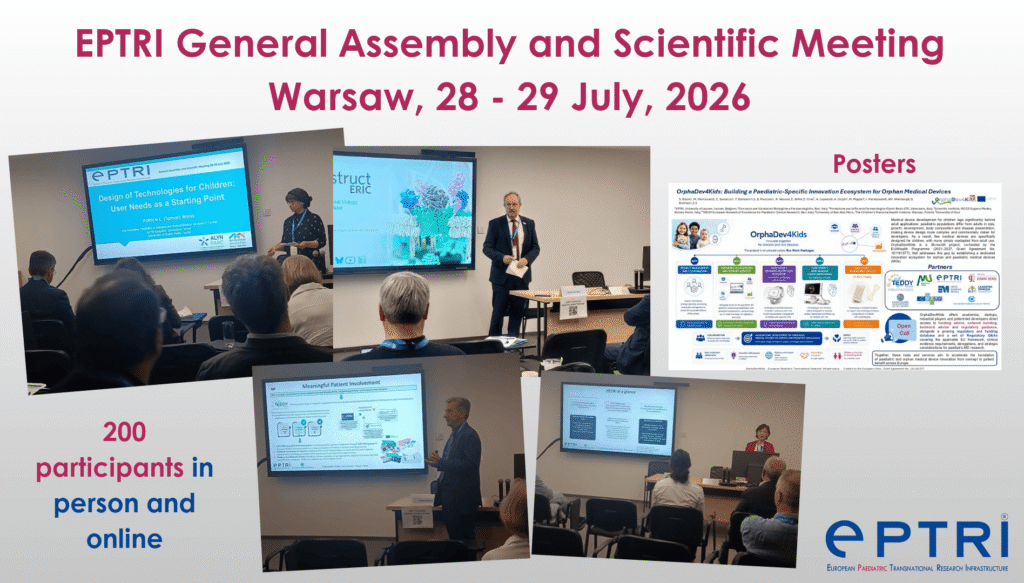
 EPTRI held its 2026 General Assembly and Scientific Meeting on 28-29 July at the premises of the Children’s Memorial Health Institute (CMHI) in Warsaw, an EPTRI member institution. Over two days, the meeting brought together researchers, clinicians, regulators, industry representatives, patients and families around a shared goal: accelerating the translation of science into safe and effective solutions for children.
Structured around six scientific sessions, the meeting covered the full paediatric innovation pathway, from the importance of collaboration among European networks and research infrastructures, medical device development and emerging technologies, paediatric regulatory challenges, health data, AI and digital approaches, innovative solutions and its translation into clinical research, reaffirming EPTRI’s role in building an integrated, collaborative European ecosystem for paediatric health.
Day 1 — European networks and paediatric medical devices
The meeting opened with the session “Future Perspectives in Paediatric Research – European Networks & Infrastructures Collaboration”, that focused on the role of collaboration and cross talk can create better research opportunities and, ultimately, better health solutions for children. The session was marked by the presentation of the results of the EPTRI Paediatric Research Needs Survey by Marek Migdal (CMHI/EPTRI), which mapped the gaps and priorities of paediatric research across Europe. Karel Allegaert (KU Leuven/EPTRI), presented the infrastructure’s integrated approach, followed by contributions from collaborative partners including Enpr-EMA (Ricardo Fernandes, conect4children), the ACT-EU initiative from the perspective of the TEDDY Network (Donato Bonifazi, TEDDY Network/EPTRI), the European Reference Networks (Luca Sangiorgi, Istituto Ortopedico Rizzoli/ERN-BOND), and major European research infrastructures Instruct-ERIC (Harald Schwalbe, Goethe University Frankfurt), INFRAFRONTIER ERIC (Radislav Sedláček, Czech Centre for Phenogenomics) and ELIXIR (Emidio Capriotti, University of Bologna), which showed how shared European resources and technologies can strengthen scientific collaboration for the benefit of children.
The afternoon was devoted to the session “Strategic Directions in Paediatric Medical Devices Development”, dedicated to highlighting how multidisciplinary collaboration, user-centred design and clinical validation can help translate innovation into meaningful medical device solutions for children. The session was opened by Tom Melvin (University of Galway) with an overview of the regulatory ecosystem and support mechanisms for paediatric medical device development — an area where EPTRI is active through its Paediatric Medical Devices Development Services and the OrphaDev4Kids project. This was followed by concrete examples of emerging technologies: child-centred design presented by Patrice (Tamar) Weiss (University of Haifa/ALYN Hospital), innovative neonatal technologies from Kathryn Beardsall (University of Cambridge), the Agilik paediatric exoskeleton for home-based rehabilitation presented by Emilia Biffi ( Scientific Institute IRCCS E. Medea), and the use of OptiTrack motion-capture technology for gait assessment in achondroplasia, presented by Inês Alves (ANDO Portugal).
Day 2 — Regulation, data and digital health, and the innovation pipeline
The morning of 29 July opened with the session “Regulatory Challenges in Paediatric Research”, which examined the evolution of paediatric regulatory science with Viviana Giannuzzi ( Fondazione per la Ricerca Farmacologica Gianni Benzi – ETS), the opportunities and challenges of Advanced Therapy Medicinal Products (ATMPs) with Marc Dooms (UZ Leuven/TRANSFORM), and the specific regulatory challenges of paediatric medical devices with Breda Kearney (BSI). Together, these presentations provided complementary perspectives on how regulatory pathways can support innovation while ensuring safety, scientific rigour and timely access to new solutions for children.
The following session “Advancing Paediatric Research through Health Data, AI and Digital Approaches” explored the potential of health data and artificial intelligence for paediatric research, featuring federated health data ecosystems (Rafał Bartczuk, Children’s Memorial Health Institute), the AMIGO proposal for integrating clinical and multi-omics data (Daniel Weiss, Ludwig-Maximilians-Universität München), the contribution of the European Health Data Space (Christophe Maes, European Institute for Innovation through Health Data), and the use of AI-based digital platforms for drug repurposing in paediatric diseases (Cosimo Altomare, University of Bari Aldo Moro). These activities connect directly to EPTRI’s Paediatric Health Data Platform and its growing engagement with the European Open Science Cloud (EOSC). The session showcased complementary perspectives and ongoing collaborations aimed at strengthening their contribution to digital health and paediatric data-driven research.
The afternoon featured two complementary sessions focused on scientific translation. “Supporting the Paediatric Innovation Pipeline” addressed the challenges of gene and cell therapy in rare diseases, with in utero genome editing for α-thalassaemia (Marios Phylactides, Cyprus Institute of Neurology and Genetics), therapeutic and functional approaches in neuromuscular diseases such as Duchenne muscular dystrophy (Nicolas Deconinck and Pablo Ruiz, Queen Fabiola University Children’s Hospital ), evidence generation in paediatric populations beyond ATMPs (Kun Shi-van Wielink, Santen Pharmaceuticals), and an industry perspective on rare and ultra-rare diseases (Seán Kilbride, Regeneron). By bringing together experts from academia and industry this session explored how different stages of the innovation pipeline, from emerging therapeutic approaches to clinical development, evidence generation and regulatory translation can help address the challenges of paediatric drug development.
Finally, the session “Innovations in Paediatric Clinical Research and Translational Science” closed the scientific programme with the SPIRIT-C and CONSORT-C guidelines for paediatric clinical trials, presented by Karel Allegaert; innovative clinical trial design methodologies by Oscar Della Pasqua ( University College London /GlaxoSmithKline R&D); patient-driven data initiatives in Duchenne muscular dystrophy (Sergiu Siminiuc, Duchenne Data Foundation); correlative microscopy and integrated structural biology approaches (Jan Přibyl, Central European Institute of Technology – Masaryk University); cryo-electron microscopy applications in paediatric disease research (Oksana Degtjarik, University of Leeds); and the development of paediatric medicines through direct powder extrusion 3D printing (Antonio Lopalco, University of Bari Aldo Moro). This session featured complementary examples of integrated approaches, from improving the design and reporting of paediatric clinical trials, to leveraging patient-generated data, advanced imaging technologies, disease modelling and innovative pharmaceutical technologies for personalised paediatric medicines.
A European ecosystem for children
Across all six sessions, one thread ran throughout: progress in paediatric research depends on collaboration — among scientists, clinicians, regulators, industry, patients and families, and among European infrastructures such as EPTRI, Enpr-EMA, ACT-EU, the European Reference Networks, Instruct-ERIC, INFRAFRONTIER ERIC and ELIXIR. The 2026 General Assembly and Scientific Meeting reinforced this shared commitment to turning scientific knowledge into safer, more effective medicines, devices and care for children across Europe.
The full programme, book of abstracts and session materials are available on the EPTRI website at EPTRI General Assembly and Scientific Meeting 2026 – EPTRI